Tuesday, 28 August 2012

The Singing Shepherd

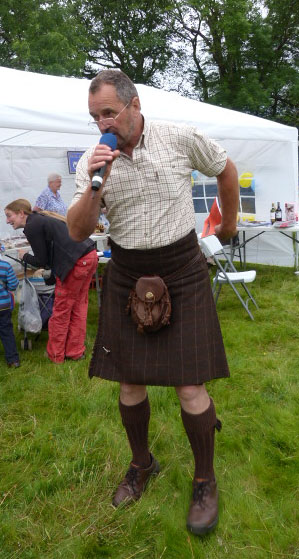
A few weeks ago I wrote about a visit to a farm on the North side of the island to watch Iain Thomson, the singing shepherd at work. Since then he has completed our deer fence, fitted it with rabbit wire and hung our heavy metal entrance gates. So now it was time to go to one of his live performances. On the island we are fortunate to have some halls that hold about sixty people and thus have an intimate atmosphere for the benefit of both musicians and their audiences.


Iain, who writes his own songs, plays the guitar and keyboard was sharing the stage with a professional musician Marc Duff. Marc is one of those artists who play many instruments and can switch from one to another whilst drawing a breath. He supported Iain’s singing with bodram, low D whistle, Erin pipes and bouzouki, whilst not playing all at once easy and smooth transitions during pieces were a delight to watch and listen to.

The programme of Iain’s music celebrated his life with its up and downs and his travels from Mull to the Scottish mainland as a shepherd, then long distance trucking all over the UK before a stint as a shearer in New Zealand before returning to Mull and his croft with his flock of sheep. As with his fencing work his professionalism with his music is very apparent, his style is quiet and entertaining, the vocals thought provoking and they tell the story of land use change from the infamous highland clearances to the present day. People are important to Iain so there are songs to tell the tale of a man from Mull who fought as a Royal Marine Commando in the Falklands war and of the Welsh Pedlar, John Jones, who died on the island after nursing families sick with typhoid back in the late 1880s. For those not fortunate to know Iain and his music it can be enjoyed on his website www.iainthomsonband.co.uk


Tuesday, 14 August 2012

Salen Show


Angus commentating
One of the highlights of the year on Mull is the annual Salen Show, or to be more precise The Mull and Morven Agricultural Society Annual Show. The show is held as you might guess in a field on the shore of the Sound of Mull just north of Salen. It has a tradition going back to 1832 and most years the weather is kind, not too hot with the rain staying away so animals and people are comfortable. The animals are Highland coos, Blackface, Hebridean and Cheviot sheep, and Dogs, yes Dogs! The whole island seems to bring their dogs for the dog show. No fancy breeds here just pets doing their bit for the days entertainment. The Mull and Iona pipe band and the Mull Fiddlers provide back ground music all played over the PA system when Angus Mackay, the show commentator, is not chivvying competitors, promoting stalls, asking for cars to be moved and generally giving information in his own inimitable style. Inner man (and woman) is not forgotten for burgers made from local meat and salmon rolls from local fish are readily available along with home baked cakes and home made sandwiches. As is usual at island functions all at very reasonable prices. The horticultural produce is auctioned off at the end of the day, this year the winning cabbage went for a fiver and was almost too heavy to lift. For the young and active there is a fell running event, terrier racing, show jumping and a tug of war, and for the rest of us a quiet amble round the stalls and a lean on the stock hurdles watching the antics of sheep and cattle and their stockmen. The stars of the show must, however, be the highland cattle with their beautifully prepared coats and coat hanger horns being paraded round the ring with mischievous dignity as they gently push their handlers
Judging
Pushing
Pulling

Monday, 6 August 2012

Ulva - Wolf Island


Ferry from Mull

The Boathouse

Sheila's Cottage  Lived in by Shiela Macfayden until 1900 and restore
recently to show the way of life as it was in Victorian times on the island.

Telfords Kirk

Leafy lanes and mossy walls


The weather was kind to us when we visited Ulva. The Viking raiders who settled there would have been very much at home as the setting in the skerries between Loch Tuath and Loch na Keal is very Scandinavian. They called it Wolf’s Island hence its modern day name. It is on the west side of Mull and just a five-minute ferry crossing from the main island of Mull on board a small open boat. Ulva and its small neighbour Gometra are privately owned so visiting I think is a privilege, though in addition to farming the twenty or so occupants are reliant on tourism. The Boathouse, a licenced cafĂ© that is a short walk from the jetty sets the scene. It is attractive and comfortable and most importantly has good food and refreshments served with a smile. There are almost no vehicles on the island, we saw a couple of old Land Rovers parked up. The transport on the island is quad bikes with trailers, and the farm tractors. Walking the rough lanes following the signposted walks is therefore a delight with no pollution and ever changing vistas. We walked through the lanes that wended their way through old deciduous woodland flanked with ancient moss covered walls to visit the Kirk that nestles in the woods overlooking Loch Tuath. It was built in Victorian times when the island had a population of about eight hundred people before the then proprietor savagely cleared the island to graze sheep. The Kirk’s architect was none other than the famous engineer, Thomas Telford who designed it to accommodate three hundred worshippers. The kirk was built with no frills and given a light airy hall with almost no adornment, as befitted the nonconformists of the time. Those were the days when the island economy was based on farming, fishing and kelp gathering, which gave the people a reasonably good life. Sadly, the kelp trade that supplied glassmakers with an important ingredient, Soda Ash, fell into decline after the invention of an industrial process to make it more cheaply than collecting and burning seaweed.

The island has connections with many famous people. Early tourists were David Livingston, Samuel Johnson and Sir Walter Scott. Lachlan Macquarrie born on the island in 1762 left to join the Army rose through the ranks to become a General but more importantly was sent to Australia as the Governor of the newly founded colony. His work earned him the accolade “Father of Australia”. He returned to Mull on his retirement and is buried almost overlooking Ulva at Gruline where his resting place uniquely is dedicated as Australian territory. It is an island that we will certainly visit

Sunday, 22 July 2012

Mull Highland Games

Whilst the rest of the country is suffering from Olympic fever, for the Highlands and Islands it is Highland Games time. Though the Games, like the Olympics, date from time immemorial and were a test for warriors, the Games, as we know them today is quite a recent event. In fact they were the idea of an English aristocrat who had a Highland estate in Victorian times. Queen Victoria’s purchase of Balmoral on Deeside is another story but suffice to say she started the trend for wealthy Southerners to own Highland estates.


So our island has its Highland Games. They are held every July on Tobermory Golf Course, high above the town with fantastic views of mainland Scotland, this year it was clear and we could see Ben Nevis. The Sound of Mull was glassy and blue beneath us. You may have guessed by now that the weather was kind though it started out dull and overcast so off we went with un-needed waterproofs. The games start right in the town as the Hereditary Chieftain, Sir Lachlan Maclean and the Games officials form up in front of the Pipe Band to march down Main Street wending the way up Back Brae to the Games field. Everyone going to the games follows the pipe band so by the time the Chieftain arrives at the fields he is followed by hundreds of people who join the march.


We were no different and arrived in the happy sea of humanity. The field is a perfect venue with Highland Dance competitions at one end, the Heavy sports at the other and all enclosed by the running track. Spectators sit on a natural grassy bank above the arena, not too far from the food tent and the bar and able to see all events from one viewpoint. There are Highland dancing and bagpipe playing competitions going on all day, field and track events also. The highlight for the majority of the spectators is the Heavy Events. These are the traditional Highland sports rarely seen outside Highland Games meetings. So 16lb hammers are thrown over 150 feet, a variety of other weights various distances all with much effort by very burly competitors. To ring the changes a 56lb hammer is also thrown over a bar, at the moment the record set in 2011 is 16 feet, a 16lb Ball is putt in the order of 50 feet.

The event known to all is Tossing the Caber. The Caber is a straight tree trunk about 19 feet long and weighing 175lbs. The thrower has to lift the Caber vertically run with it and toss it so that it falls away from him. Sometimes successfully, sometimes it bounces and drops back towards judge and caber tosser who need to get from under. As all this is going on pipe bands entertain, this year the champion Oban High School Band shared the honours with our own Mull and Iona Pipe Band. As the games drew to a close the “heavies” staged a knock out competition heaving a 42lb weight over a bar above their heads, the last competitor breaking the record at 18 feet without breaking his head!!!


Wednesday, 18 July 2012

Sheep Shearing and singer

Large Dutch Zwartble Ram patiently waiting
We were offered the opportunity to visit a farm in the north of the island to watch the “Singing Shepherd” Iain Thomson shearing sheep and to take photographs whilst he did so. By the time we arrived he had clipped over a hundred so was in no voice to sing! In a previous life I had a few sheep so shearing and the smell of sheep was not new to me. Nevertheless, it was fascinating to watch an expert set the sheep on its tail and get it in exactly the right position to cut the fleece away. The hallmark of a good shearer is to remove the fleece in one, remove it quickly and not cut the animals skin.
Upended and fleece coming off

The speed and flow of shearing was almost musical to watch!

When the shepherd is not shearing, tending sheep he is either fencing or singing. Fencing on this island means serious deer fencing and Iain has erected more than his fair share, including ours, over the years.

He is an accomplished singer songwriter with several professionally produced Cds. His voice has an easy listening style and his repertoire includes many well know folk songs, but for us his some of his best are the songs that he has written about the island and his life both on and off the island on a cd called Fields of Dreams. Iain also finds time to go on tour and sing at venues on the island and is much in demand. For details of the cds and song lyrics visit www.iainthomsomband.co.uk